Click the following link to view the PDF of this paper: Geophysical Methods for Seismic Site Classification

Nathaniel Morehouse
Project Manager
Atlantic Testing Laboratories
Brian Barnes, PE
Director of Geotechnical Services
Atlantic Testing Laboratories
Determining the seismic site classification is a critical component of a geotechnical evaluation, and is an important consideration for engineers during structural design. The seismic site classification is used to determine a structure’s Seismic Design Category (SDC) and seismic forces that the structure will be subjected to during a seismic event. Accurate seismic site classification is critical in providing reliable, safe, and cost-effective structural designs for buildings and infrastructure.
The 2025 Building Code of New York State references the procedures outlined in Chapter 20 of ASCE 7-22 for determining seismic site classification. ASCE 7-22 describes eight seismic site classifications, A through E, with intermediate classifications BC, CD, and DE that are based on a site’s average shear wave velocity.
ASCE 7-22 states that a site’s seismic site classification shall be based on the average shear wave velocity parameter, Vs, derived from the measured shear wave velocity profile from the ground surface to a depth of 100 feet. Where shear wave velocities are not measured, the shear wave velocities may be estimated using correlations with other geotechnical parameters such as Standard Penetration Testing (SPT) values, Cone Penetration Testing (CPT) tip resistance, and shear strength; however, a “penalty” is applied to the correlated value. The “penalty” consists of evaluating three average shear wave velocity profiles (avg Vs, 1.3Vs, and Vs/1.3) and selecting the most critical site classification for seismic design. Site classifications based on correlated shear wave velocities may result in a more conservative seismic design category and less efficient structural design and increased construction cost.
Example CPT data profile with shear wave velocity
A site’s shear wave velocity profile can be directly measured using various geophysical testing methods. Two common methods are Seismic Cone Penetration Testing (SCPT) and Multichannel Analysis of Surface Waves (MASW) surveys. Both methods can be used to determine the average shear wave velocity for a site and have their own set of advantages and limitations; therefore, their use should be determined on a project-by-project basis.
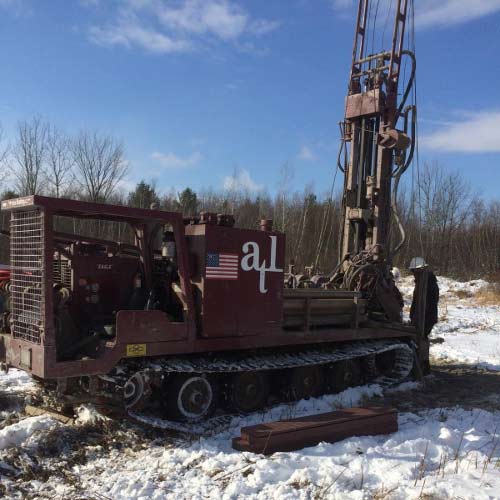
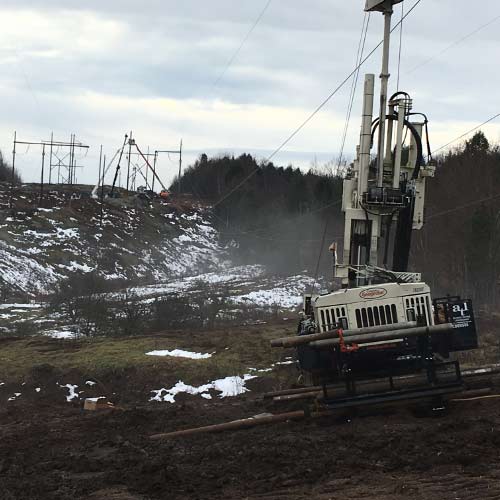
SCPT is performed by advancing a CPT probe equipped with a geophone to a depth of 100 feet. The SCPT probe is stopped at specified depth intervals throughout advancement, and a surface source (hammer strike) is applied. The shear wave velocity is measured at each specified depth interval.
SCPT Advantages
- Is performed in conjunction with CPT borings that collect other geotechnical parameters
- May provide more accurate data in very soft soil conditions
SCPT Limitations
- Requires equipment with direct push capabilities (CPT/drill rig or other heavy equipment)
- Depth of exploration can be limited if hard/compact soils, boulders, or bedrock are encountered
- Can be less cost-effective if used solely measuring seismic data due to mobilization and equipment cost
A MASW survey is performed by setting an array of geophones along the ground surface connected to a seismograph and applying a surface source (hammer strike) at various distances from the geophone array. The seismograph measures the generated wave data gathered by each geophone. The wave data is processed to determine shear wave velocity vs. depth and the average shear wave velocity profile.
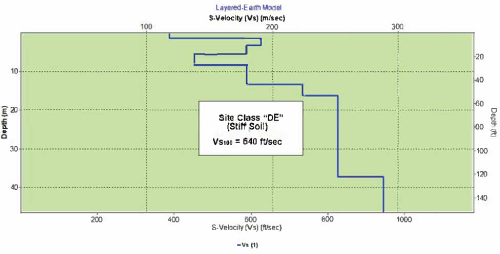
Example shear wave velocity profile produced with an MASW survey
MASW Survey Advantages
- Does not require additional equipment
- Non-invasive
- Depth of measurement is not limited by subsurface conditions
- Can be more cost-effective (reduction of equipment, time, personnel)
MASW Survey Limitations
- Requires approximately 300 linear feet of open area to place geophone array
- Vs is averaged over layers and may not identify thin layers having different shear wave velocities
Direct measurement of a site’s shear wave velocity profile is more accurate and reliable than using correlations for determining site classification in seismic design. Accurate shear wave velocity testing and seismic site classification are crucial to providing a safe and economical structural design. Geophysical testing methods combined with conventional geotechnical investigation methods provide the most comprehensive information for accurate and reliable seismic site classification.
For more information, contact Nate Morehouse at 315-386-4578, info@atlantictesting.com, or visit www.AtlanticTesting.com.
|
ASSOCIATED SERVICES |
 |