Click the following link to view the PDF of this paper: Geotechnical Uses of Recycled Concrete Aggregate

Jesse O’Dell, EIT
Project Engineer
Atlantic Testing Laboratories
Brian Barnes, PE
Director of Geotechnical Services
Atlantic Testing Laboratories
With the increasing awareness of sustainable construction and resource conservation, the use of Recycled Concrete Aggregate (RCA) has emerged as an attractive alternative to imported virgin aggregate for a wide range of construction projects. With appropriate processing and quality control, RCA is suitable for structural backfill, and as fill below slabs, foundations, and pavements. It may also be used as earthwork material on New York State Department of Transportation (NYSDOT) projects in accordance with Standard Specification Section 733-19.
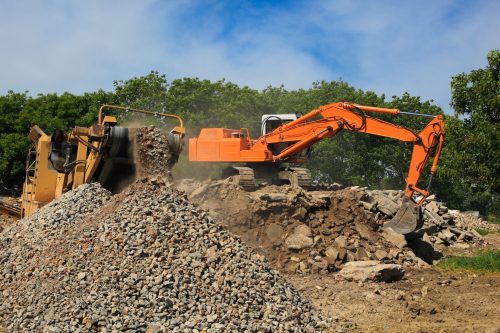
RCA produced from crushed Portland Cement Concrete (PCC) is typically sourced from the demolition of nearby infrastructure such as roadways, bridges, sidewalks, and building foundations. The reclaimed PCC is processed at an approved recycling facility for reuse, reducing costs and environmental impacts associated with mining and hauling virgin materials. RCA is commonly processed at a New York State Department of Environmental Conservation (NYSDEC) Part 360-certified recycling facility to ensure compliance with environmental and materials management regulations. The concrete is screened for contaminants, mechanically crushed, and processed to meet project specifications for various fill materials.
Due to the high pH of recycled concrete, specifications typically do not allow RCA to be placed in direct contact with aluminum piping or other materials susceptible to corrosion.
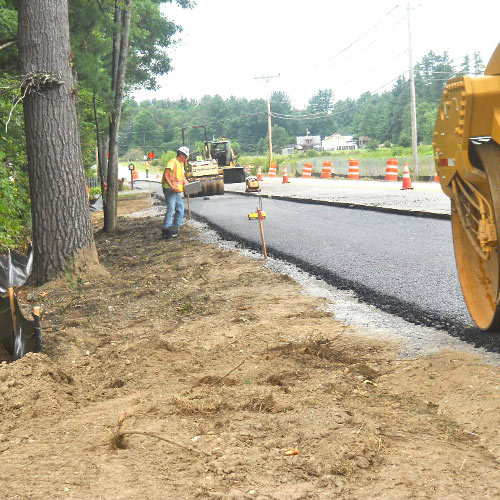
When properly processed and tested, RCA can be installed using the same construction methods as other aggregate materials. RCA can be processed to meet the same project specifications as virgin fill materials, with comparable strength, stability, and drainage characteristics, providing field quality control standards are met.
It is important to note that in-place nuclear density testing during RCA placement may yield low dry density and percent compaction values. Since RCA contains residual bound water and trapped hydrogen within its cement paste and mortar fractions, gauge readings overestimate the material’s moisture content, leading to artificially low density and percent compaction. Gauge moisture corrections may therefore be necessary. Alternatively, the Geotechnical Engineer may utilize visual inspection and proof rolling techniques to evaluate compaction of RCA.
Atlantic Testing Laboratories (ATL) provides comprehensive geotechnical laboratory and field evaluation services to verify RCA compliance with NYSDOT requirements and project specifications.
For more information, contact Brian Barnes at 315-735-3309, info@atlantictesting.com, or visit www.AtlanticTesting.com.
|
ASSOCIATED SERVICES |
 |