Click the following link to view the PDF of this paper: Verifying Electrostatic Resistance of Resilient Flooring

Steven N. Moore, PE
Director of Materials Testing Services
Atlantic Testing Laboratories
In today’s high-tech and safety-critical environments, controlling electrostatic discharge (ESD) is more important than ever. From data centers and cleanrooms to healthcare facilities and defense manufacturing operations, unwanted static electricity can damage sensitive equipment, disrupt operations, and create safety hazards. ASTM F150 testing provides a proven method for evaluating the electrical resistance of conductive and static dissipative resilient flooring, helping organizations maintain safe and reliable environments.
ASTM F150, Standard Test Method for Electrical Resistance of Conductive and Static Dissipative Resilient Flooring, is a test method that measures the electrical conductance and resistance of resilient flooring materials, including both tile and sheet flooring products. The test is commonly used for facilities where personnel-generated static electricity must be controlled.
Static control flooring serves as a pathway that safely dissipates electrical charges between people, equipment, and ground. Without proper flooring performance, static charges can accumulate and discharge unexpectedly, potentially causing:
- Damage to sensitive electronic components
- Data corruption and equipment malfunctions
- Contamination risks in cleanroom environments
- Safety concerns in explosive or combustible atmospheres
- Increased operational downtime and maintenance costs
ASTM F150 testing verifies that flooring materials provide the electrical resistance characteristics necessary to support effective static control programs.
ASTM F150 testing is widely utilized across numerous industries, including:
- Semiconductor and electronics manufacturing
- Data centers and computer rooms
- Pharmaceutical and biotechnology facilities
- Hospitals and healthcare environments
- Aerospace and defense operations
- Cleanrooms and controlled environments
- Munitions and explosive-handling facilities
In these applications, maintaining proper electrostatic flooring resistance is essential for protecting personnel, products, and critical equipment.
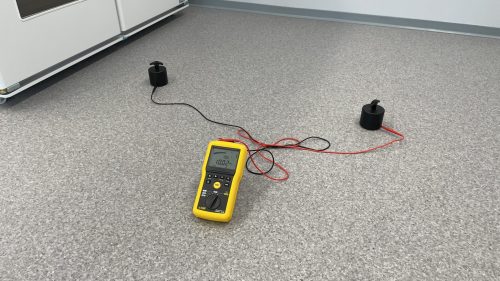
ASTM F150 testing delivers confidence that static control flooring will perform as intended in environments where electrostatic discharge can have costly or dangerous consequences. By verifying electrical resistance characteristics, organizations can reduce risk, improve reliability, and ensure long-term protection for personnel, equipment, and operations.
ANSI/ESD STM 11.11 and ANSI/ESD STM 97.1 are two additional test procedures that could supplement ASTM F150 testing. ANSI/ESD STM 11.11 is a surficial test performed on planar materials like flooring as well as packaging materials and work surfaces. It can be performed on conductive, static dissipative, or insulative materials. ANSI/ESD STM 97.1 is specific to flooring and evaluates the complete floor-to-grounding system, and includes the person, the ESD footwear, ESD flooring, and the grounded connection, making it a more realistic assessment of the ESD system rather than the individual components.
While ASTM F150 and the associated ANSI/ESD tests do not specify a mandatory retest interval, industry best practices recommend testing static-control flooring at installation and at least annually thereafter. Facilities operating in highly sensitive environments may choose semi-annual or quarterly testing to ensure continued compliance and protection from electrostatic discharge. Additional testing should be performed following repairs, modifications, or significant changes in facility conditions.
For more information or to schedule testing, contact Steve Moore, PE at 518-383-9144, info@atlantictesting.com, or visit www.AtlanticTesting.com.