Click the following link to view the PDF of this paper: AASHTO T 358 – Concrete Surface Resistivity & Chloride Tests for Concrete Durability

Steven N. Moore, PE
Director of Materials Testing Services
Atlantic Testing Laboratories
The New York State Department of Transportation (NYSDOT) has implemented a new concrete specification that requires surface resistivity (AASHTO T 358) to be measured during concrete mix development, and as part of final acceptance for the new Performance Engineered Mix (PEM) requirements.
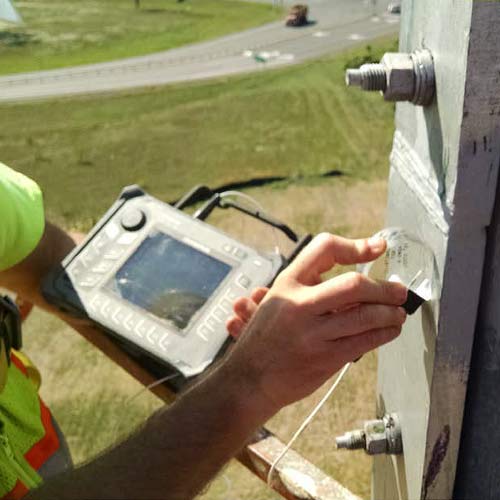
- AASHTO T 358 evaluates concrete resistance to chloride penetration by measuring the surface resistivity of a standard concrete cylinder
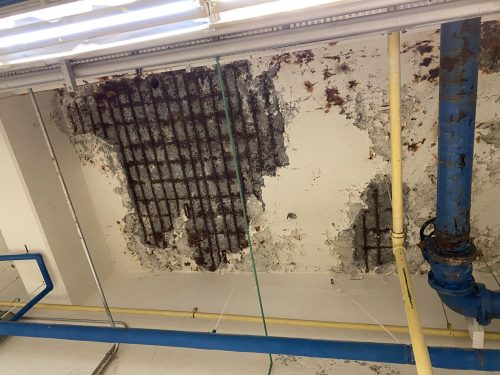
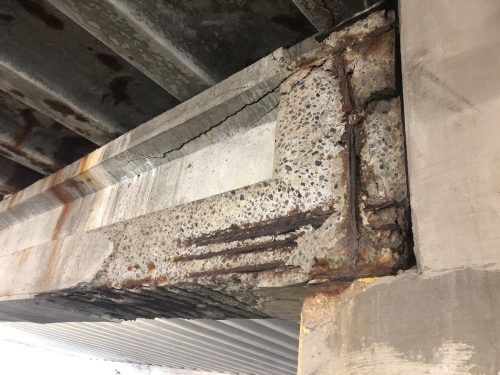
Research has shown that concrete with a high surface resistivity has low chloride permeability, making it less susceptible to chloride penetration and thus increasing its long-term durability.
Chloride (Cl-), the negatively charged ion of the element chlorine (Cl), can accelerate the corrosion of reinforcing steel and reduce the long-term durability of reinforced concrete. Due to the high solubility of chloride in water, its natural abundance in many rocks, minerals, and soils, and the inherent porosity and permeability of concrete, chlorides can be easily introduced into concrete from both external sources (deicing salts, seawater, groundwater) and internal sources (aggregates, mix water, accelerating admixtures).
Test methods to determine the concentration of chloride in hardened concrete include:
- ASTM C1218 determines the concentration of water-soluble chlorides in concrete; water-soluble chlorides are readily available to accelerate corrosion of embedded steel
- ASTM C1152 determines the concentration of acid-soluble chlorides; acid-soluble chlorides include all chlorides in the concrete, including those that are chemically bound
- AASHTO T 260 determines both the water- and acid-soluble chloride content of the concrete
Concrete’s resistance to chloride penetration can be evaluated using the following test methods:
- ASTM C1202 is used to determine the concrete’s resistance to chloride ion penetration
- NT Build 492 is a European test method that is used to determine the chloride migration coefficient, which is also a measure of the concrete’s resistance to chloride ion penetration
ATL performs the referenced chloride content and penetration resistance test methods from our accredited laboratories.
For more information, contact Steve Moore, PE at 518-383-9144, info@atlantictesting.com, or visit www.AtlanticTesting.com.
|
ASSOCIATED SERVICES |
 |