Click the following link to view the PDF of this paper: Full-Time Asbestos Project Monitoring vs Air Sampling
Andrew Amell
Group Leader
Atlantic Testing Laboratories
Asbestos abatement projects in New York State (NYS) that involve the removal, repair, enclosure, or encapsulation of an asbestos-containing material (ACM) often require a certified third party to conduct area air sampling and serve as a Project Monitor providing final visual inspections. These requirements primarily depend on the type and quantity of ACM removal.
The third-party firm must hold an asbestos-handling license and staff must be certified by New York State Department of Labor (NYSDOL) as an “Air Sampling Technician” and/or a “Project Monitor.” Regulations require the third-party firm be contracted directly by the owner (or owner’s agent) of the building or structure for which the abatement is occurring. It is important to note the abatement contractor cannot serve as the owner’s agent. The intent is to eliminate conflicts of interest for the air sampling technician or Project Monitor related to the oversight of work performed by the abatement contractor.
Area air sampling consists of collecting samples from inside and outside regulated work areas for subsequent laboratory analysis and comparison with established standards. As defined by 12 NYCRR Part 56, a Project Monitor oversees the scope, timing, phasing and/or remediation methods to be utilized on, and the completeness of any asbestos project.
As described below, there are two options for third-party air monitoring and/or project monitoring during asbestos abatement.
Air Sampling and Analysis with Project Monitor Final Visual Inspection
Provisions for air sampling and Project Monitor visual inspection are described in 12 NYCRR Parts 56-4 and 56-9 and are dictated by the amount of ACM removal (measured in square feet or linear feet).
Air sampling may be conducted prior to starting abatement (background air sampling), during abatement, and after completion of abatement (final air clearance sampling). 12 NYCRR Part 56-4 requires third-party air-sampling for all small and large projects. Small projects include abatement of ACM covering greater than 10 and less than 160 square feet or greater than 25 and less than 260 linear feet. Large projects include abatement of ACM in quantities of 160 square feet or more, or 260 linear feet or more.
A Project Monitor can fulfill a variety of duties during an abatement project; however, the only responsibility specified in NYS regulations is the final visual clearance of abated work areas. Pursuant to 12 NYCRR Part 56-9, the minimum Project Monitor requirement is to be on-site to perform the final visual inspection of all small and large work areas.
Full-Time Project Monitor and Air Sampling and Analysis
Supplemental requirements of 12 NYCRR Parts 56-4 and 56-9, project specifications, NYSDOL site-specific variances, and/or building owner’s direction may dictate commissioning the services of a full-time Project Monitor. Responsibilities for a full-time Project Monitor may vary and should be identified in the project specifications, conditions set forth in a NYSDOL site-specific variance, and/or contract documents between the Project Monitor and owner (or owner’s agent).
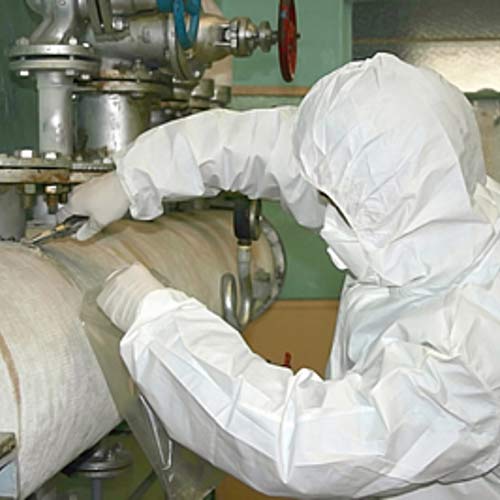
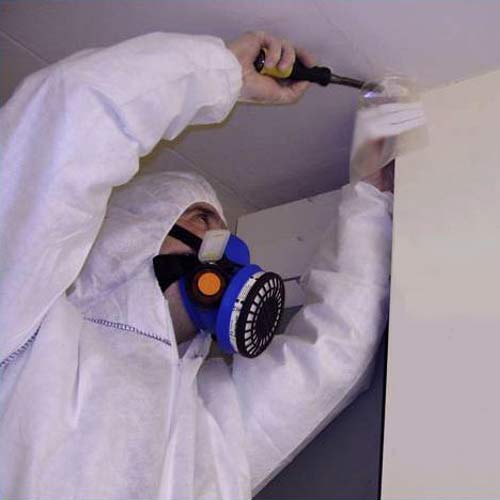
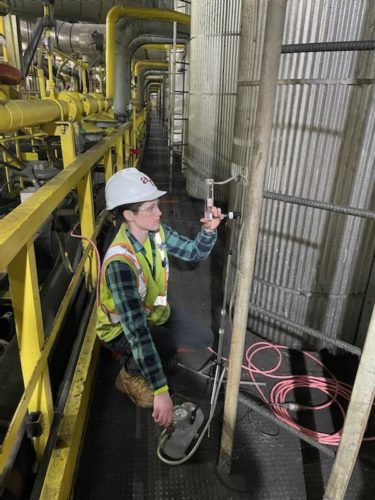
A full-time Project Monitor may be required not only to meet requirements for air sampling and final visual inspections, but also to provide day-to-day observation and documentation of the abatement contractor’s work. Activities often include documenting observed work practices, notifying owner and abatement contractor’s supervisor of potential noncompliance with asbestos regulations, and verifying that project notifications and worker certifications are correct and current. The Project Monitor generally serves as the owner’s representative and may enter the asbestos work area to conduct inspections and relay progress and any discrepancies to the owner or owner’s representative.
Although both options for third-party air sampling and Project Monitor services meet minimum regulatory requirements, a full-time Project Monitor presents significant advantages for the building owner. Some common advantages are listed below.
- Certified Project Monitors are typically certified as Air Sampling Technicians and can serve in both capacities concurrently. This generally allows a single representative to be on-site to meet the minimum requirements of 12 NYCRR Parts 56-4 and 56-9, in addition to providing supplemental Project Monitor duties.
- A certified Project Monitor has direct access to the work area for documentation of work practices, measurements for removed or remaining ACM, visual inspections of items or objects being cleaned and removed from the work area, and obtaining other information regarding the abatement work that may be beneficial to the owner or their design team.
- Waste generation and disposal can be monitored and tracked, with inspection and documentation of waste removal via waste shipment logs and manifest review.
- Operation of negative air pressure systems can be routinely checked to confirm the required amount of negative air is maintained in accordance with project specifications and/or asbestos regulations.
- Multiple daily checks of the asbestos work area containment can be provided to address breaches and timely notification and repair.
- Observed work practice discrepancies can be immediately identified and communicated to the abatement contractor’s supervisor and building owner for corrective action, thus limiting the potential for regulatory violations.
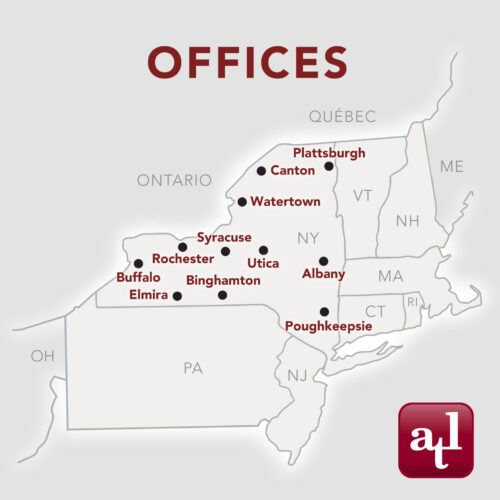
If you have asbestos abatement projects requiring third-party asbestos air sampling and/or project monitoring, ATL has experienced and certified environmental professionals available throughout New York State.
For more information, contact Andrew Amell at 315-699-5281, info@atlantictesting.com, or visit www.AtlanticTesting.com.
|
ASSOCIATED SERVICES |
 |